Published Date
July 28, 2026
Author
Aarvak Diagnostics
Read Time
8 min
Category
Radiology
Breathless on the Stairs? What a PFT Test in Gurugram Actually Tells You
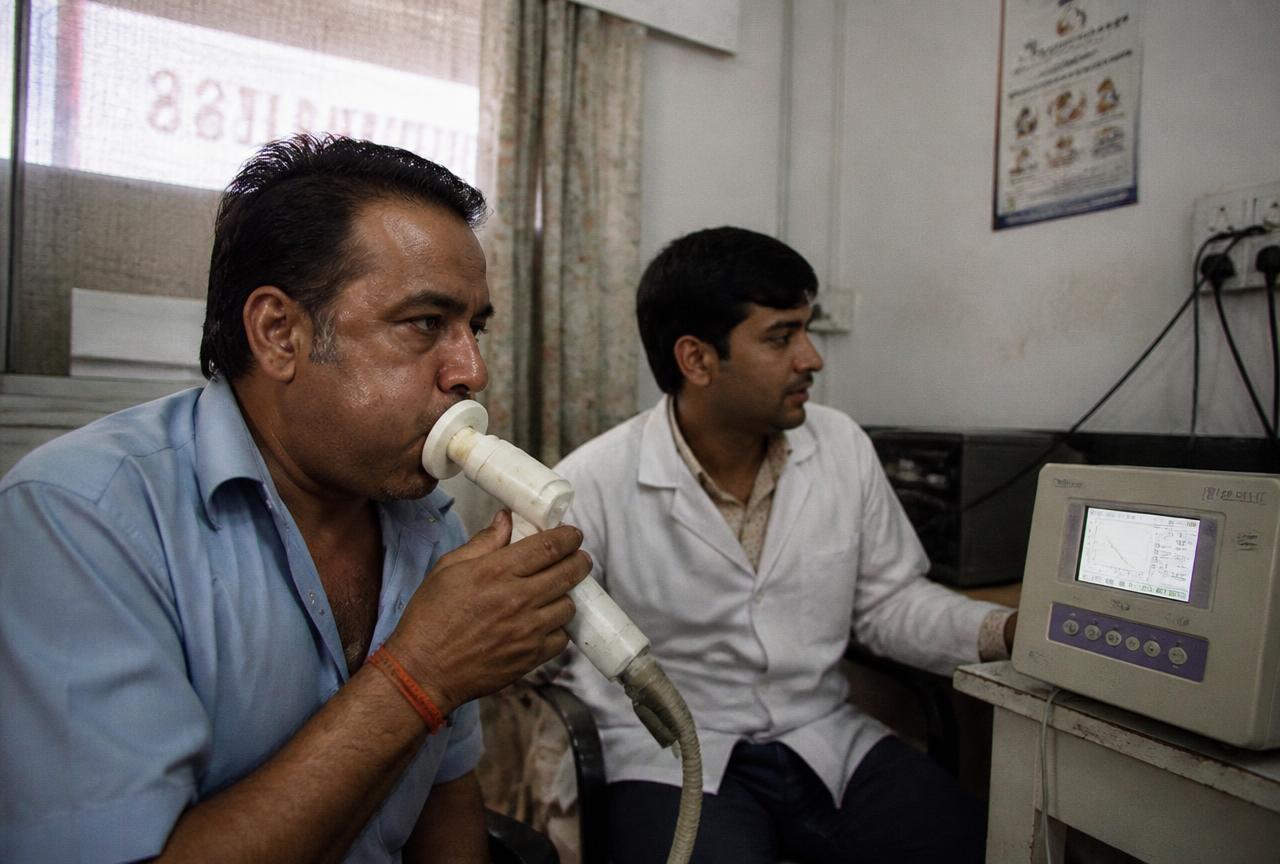
Quick answer: A Pulmonary Function Test (PFT), most commonly spirometry, measures how much air you can breathe in and how fast you can blow it out. Key results are FEV1 (air blown out in one second), FVC (total air blown out) and the FEV1/FVC ratio. A low ratio suggests obstruction (asthma, COPD); a reduced FVC with a normal ratio suggests restriction (stiff lungs or chest wall). Improvement after an inhaler (bronchodilator reversibility) supports asthma. The test is painless, takes about 15–20 minutes, and needs simple preparation. It's advised for persistent cough, breathlessness, wheezing, smokers over 40, and people exposed to dust or pollution.
Breathlessness on stairs is easy to blame on being "out of shape". Sometimes it is. But it can also be an early sign of asthma, COPD or other lung conditions — and in Gurugram, where winter AQI regularly reaches hazardous levels, lung problems are increasingly common in younger adults too.
What a PFT Measures
FVC (Forced Vital Capacity)
The total volume of air you can forcefully exhale after a full breath in.
FEV1 (Forced Expiratory Volume in 1 Second)
How much of that air comes out in the first second. Narrowed airways slow this down.
FEV1/FVC Ratio
- Normal: usually above about 0.70 (lower limits also depend on age)
- Low: suggests obstructive disease — asthma or COPD
PEF (Peak Expiratory Flow)
Your fastest exhaled airflow — also measured at home with a peak flow meter for asthma.
Bronchodilator Reversibility
If results are abnormal, the test is repeated 10–15 minutes after an inhaler. Significant improvement suggests asthma; little improvement is more typical of COPD.
Common Result Patterns
- Obstructive pattern (low FEV1/FVC): asthma, COPD, chronic bronchitis
- Restrictive pattern (low FVC, normal or high ratio): lung fibrosis, chest wall problems, obesity, neuromuscular weakness — usually needs further tests
- Mixed pattern: features of both
- Normal: symptoms may have another cause — heart, anaemia, fitness, anxiety — which your doctor will explore
Who Should Get a PFT?
- Cough lasting more than three weeks, or recurring every winter
- Breathlessness on exertion, wheezing or chest tightness
- Smokers and ex-smokers over 40
- People with asthma, to confirm diagnosis and monitor control
- People exposed to dust, fumes or chemicals at work — construction, factory, traffic, cleaning
- Before certain surgeries
- During Gurugram's smog season if symptoms worsen — see air pollution lung tests
How to Prepare
- Don't smoke for at least 4–6 hours before
- Avoid a heavy meal for 2 hours before
- Avoid alcohol for 4 hours before
- Avoid vigorous exercise for 30 minutes before
- Wear loose clothing
- Ask your doctor whether to stop inhalers before the test — and for how long. Don't stop on your own
- Tell the technician if you have had recent chest or eye surgery, a recent heart attack, or are coughing up blood
What Happens During the Test
- You sit upright, wearing a soft nose clip
- You take the deepest breath you can, seal your lips around the mouthpiece, and blow out as hard and fast as possible for as long as you can
- This is repeated at least three times for consistent readings
- You may then take an inhaler and repeat the test after 10–15 minutes
You may feel briefly light-headed or cough — that's normal.
Tests Often Done With a PFT
- Chest X-ray — see chest X-ray guide
- CBC with eosinophil count and IgE — for allergic asthma. See allergy testing
- SpO2 — oxygen saturation
Frequently Asked Questions
What is a PFT test used for?
A PFT measures lung function to diagnose and monitor asthma, COPD and other lung conditions, and to evaluate breathlessness or chronic cough.
Is a PFT test painful?
No. A PFT is painless. You breathe into a mouthpiece following the technician's instructions.
How long does a PFT take?
Usually about 15–20 minutes, including a bronchodilator test if needed.
What is a normal FEV1/FVC ratio?
A ratio above about 0.70 is generally considered normal in adults, though lower limits depend on age and other factors.
Should I stop my inhaler before a PFT?
Your doctor may ask you to pause certain inhalers before the test. Don't stop any medicine without your doctor's advice.
Can PFT diagnose asthma?
A PFT showing obstruction that improves significantly after a bronchodilator strongly supports a diagnosis of asthma.
Book a PFT Test in Gurugram
Aarvak performs PFT/spirometry at our Sector 67 centre, convenient from Sohna Road and Golf Course Extension Road. Book a PFT or call +91 92663 33711. For workplaces, we run on-site PFT screening.
This article is for general information only. Please consult your doctor for interpretation of results.